
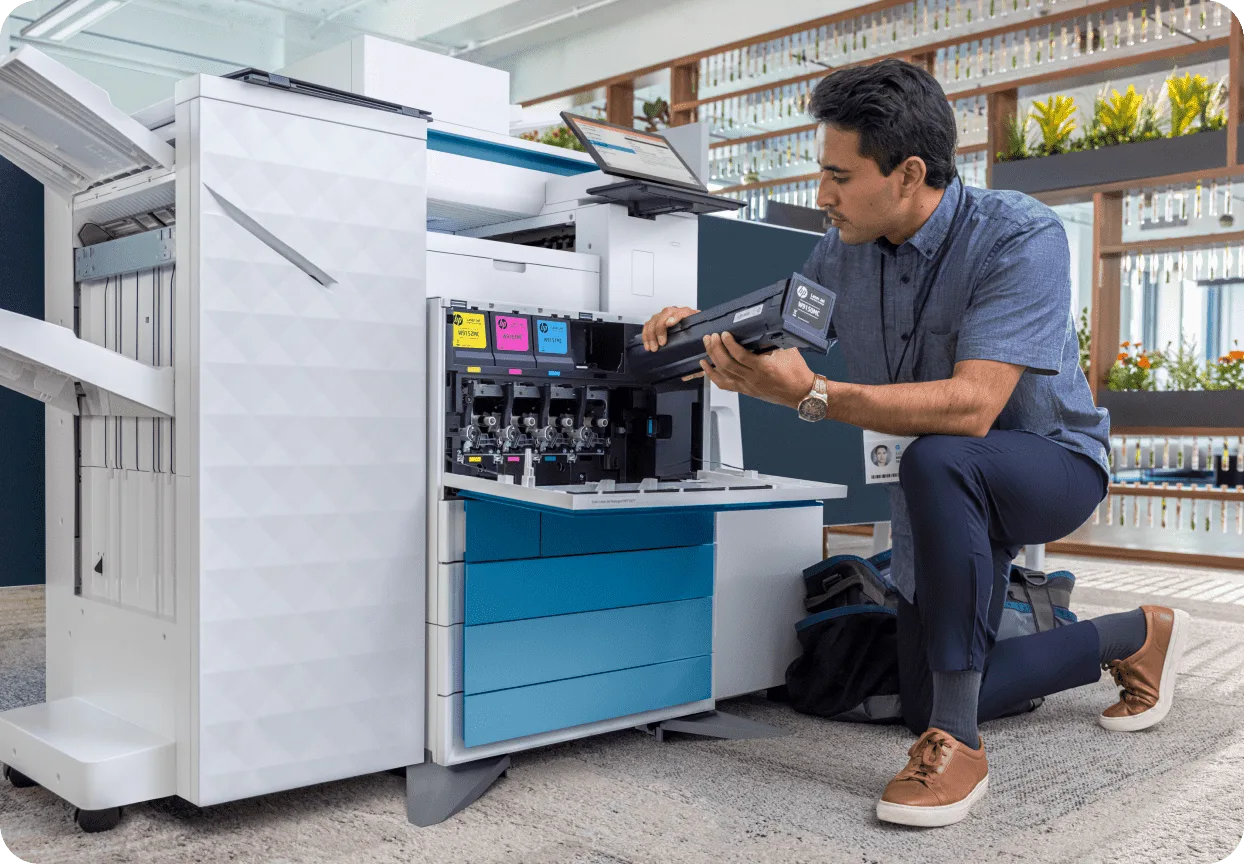
Buying a printer is the cheapest decision on the purchase order and often the most expensive one over three years. The sticker price covers the hardware. It does not cover toner, paper, repairs, IT time, or the print jobs that sit in a queue because a drum needs replacing.
Managed print services (MPS) flip that model. A provider assesses your print fleet, takes responsibility for keeping it running, and bills you for the outcome, usually as a cost per page or a flat monthly fee. Here is how the two approaches compare.
Where the real cost of printing sits
Most printing costs are not in the printer. They are in consumables, service calls, paper, energy, and staff time spent on problems that have nothing to do with the work being done.
When you buy printers, you carry all of those costs yourself, and they are hard to see. Toner runs out on a Friday afternoon. Someone orders a replacement at retail price. A department prints in colour when black and white would do. Nobody tracks any of it.
An MPS contract puts those costs on one invoice, which makes them easier to predict and to control.
Buying printers: what you gain and what you give up
What you gain
- A lower upfront outlay for each device
- Full control over which models you buy and where they go
- No contract to renew or exit
What you give up
- Ownership of every repair, firmware update, and supply order
- Unpredictable monthly spend, because toner and service costs vary with usage
- Little visibility into which devices print the most, or who prints what
- A fleet that drifts out of date, with older machines kept running past their useful life
Managed print services: what changes
Predictable costs. Most MPS contracts bill per page or per month, so you can budget for printing the way you budget for a phone plan. Ask for the cost per page for black and white and for colour, and compare those figures to what you pay now.
Right-sized fleets. A proper assessment usually finds more devices than a business needs, or the wrong kind of device in the wrong place. Consolidating a fleet can reduce the number of machines, the energy they use, and the number of service calls.
Supplies handled for you. Remote monitoring tells the provider when toner is low, so cartridges arrive before a machine runs out. Your staff stop managing the stock cupboard.
Stronger security. Printers and multifunction devices store documents, connect to networks, and receive firmware updates. Many are overlooked in security planning. An MPS provider can keep firmware current, enable secure print release so documents print only when the user is standing at the device, and keep an audit trail of who printed what.
Less IT time. Your IT team no longer chases driver problems, offline devices, or paper jams. The provider handles those, and your team can spend the time on work with a bigger payoff.
Fewer surprises. Proactive monitoring catches failing hardware before it stops a department. Service levels in the contract set how quickly a fault must be fixed.
The trade-offs to check before you sign
An MPS contract is not automatically cheaper. Read it closely before you commit.
- Per-page rates. A low headline rate can hide high charges for colour or large print volumes. Ask for a sample invoice based on your real usage.
- Contract length and exit terms. Long contracts with auto-renewal can lock you in when your needs change.
- Service levels. Check the response time for a fault, what happens during an outage, and whether there are penalties if the provider misses its targets.
- Ownership of data. Confirm what the provider collects from your devices, where it is stored, and what happens to it when the contract ends.
- Equipment. Find out whether the provider supplies new hardware, refurbished hardware, or your existing machines, and who pays for replacements.
Which option fits your business?
Buying printers can make sense for a very small office with one or two devices, low volume, and someone comfortable handling supplies and repairs. Even then, it is worth tracking your print costs for a month before you decide.
Managed print services usually make more sense when you have several devices, several sites, staff who print in volume, or an IT team that does not have time to manage printers. A short assessment is the best way to find out which group you are in. Ask for a report that covers current device count, monthly print volume, colour versus black-and-white use, and current supply and service spend. Then compare the total annual cost of each option, not just the hardware price.
Ready to see what your print fleet really costs? Contact ATechbusiness for a no-obligation print assessment.